Public Gardens of note – Lisbon and Central
Click on the Garden Name below for more information
Ajuda Botanical Garden
The Ajuda Botanical Garden (JBA), ISA’s Technological Support Unit, has belonged to ISA since 1910, as part of its teaching and research infrastructure. It was founded in 1768 and designed by an Italian botanist, Domingos Vandelli, who came from Padua and was called by King José to teach his princes.
https://www.isa.ulisboa.pt/jba/apresentacao
Quinta dos Azulejos, (Colegio Manuel Bernardes), Paço do Lumiar, 1600-549 Lisbon
Now a private school and so visits are by special appointment.
The garden is designed in the Mediterranean-Islamic tradition to be entirely inward-looking.
Built mid-18th century, when azulejaria (ceramic tiling) was at a wonderful high point with three-dimensional tiling, entirely clothing pillars, planting troughs, arches, benches and other sculptural and architectural surfaces, presenting an impressive variety of themes (from biblical scenes to classical mythology) in arches, octagonal columns and benches. These were placed in different phases, presenting the evolution of tile art in Lisbon from the Baroque to the Rococo periods.
www.cmb.pt
Palace of the Marquis of Pombal, (Palace of the Count of Oeiras), Oeiras
Had the Baroque continued to evolve as a style of garden, Pombal Palace gardens show what might have happened elsewhere. The gardens are richly decorated with rustic columns and pebble paving and azure tiling. There is also a cascade, a grotto, a pillar, a waterfall with semi-circular basins.
Jardins da Quinta Real de Caxias, Belem, Lisbon
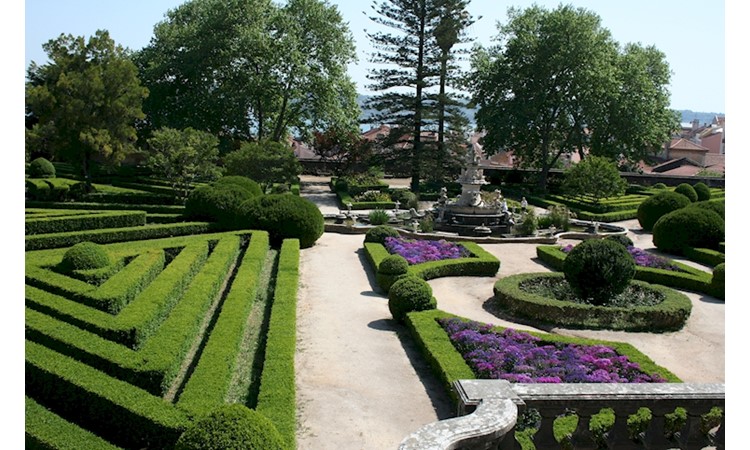
The gardens of the Caxias Royal Estate, built in the 19th century as a summer residence is made up of box hedging, but is known for a monumental baroque waterfall representing the mythical bath of Diana. The waterfall is in the middle of a salmon color line galleries with terraces and landscaped terraces.
The gardens have geometric lines and are decorated with sculptures. Broad and rectilinear avenues, fountains and different elements of the surrounding countryside all contribute to the garden environment.
Quinta dos Loridos, Buddah Eden garden, Carvalhal, Obidos
A winery with the largest oriental garden in Europe focusing on statuery.
It’s 35 hectares was created as a reaction to the destruction of the Buddha’s of Banyan, erasing masterpieces of late-period Gandhara art.
From Buddhas, pagodas, terra cotta statues and the various carefully-placed sculptures which can be found throughout the gardens, it is estimated that some six thousand tons of marble and granite were used to create this monumental work of art.
The central staircase is the focal point of the garden, where the golden Buddhas offer you a calm welcome.
At the central lake, KOI (Japanese carp) fish can be seen, and sculpted dragons rise out of the water.
There is also the opportunity to see the seven hundred hand-painted terra cotta soldiers, each of them unique copies of those which were buried some 2,200 years ago.
Quinta da Bacalhôa, Azeitao, Setubal
The estate and the Palace of Bacalhôa have the distinction of dating back to the founders of the Avis dynasty.
Over the centuries, the architecture, the decor and the gardens of the Palace have been influenced by various owners, who drew inspiration from their travels across Europe, Africa and the Orient to transform the property into a rare gem.
As time has progressed, the estate has been beautified by Portuguese hand-painted tiles from the XV and XVI centuries evoking Moorish designs, and with a lakeside house with views over the estate and where the very first dated painted tile in Portugal can be found.
http://www.azeitao.net/quintas/bacalhoa_ingles.htm