Public Gardens of note – Portugal Mainland North
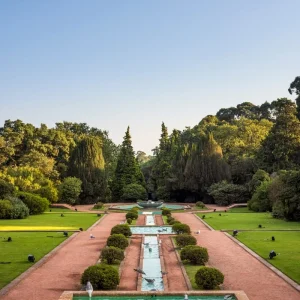
The gardens of the northern climate means they won’t represent the Mediterranean flora, but are worthwhile visits due to their abundance of flora and garden aesthetics. This selection is not exhaustive but are noteworthy.
If you are planning a tour then the following web sites give information for gardeners.
Click on the Garden Name below for more information
Portuguese Historical Gardens
Garden of Quinta de Santo Inácio, 4430-809 Avintes, V. N. de Gaia, Porto
The house and gardens of this estate, Quinta de S. Inácio, are dated from the XVIII century. Today, the garden and surrounding woods are classified as being of public interest: a centenary romantic garden, bordered by shrubs, with azaleas, rhododendrons, camellias and other flowers, topped by a canopy of various species of eucalyptus, oaks, pines and many other trees. The gardens now include a zoo.
www.zoosantoinacio.com/index.php
Villa d’Allen, Porto
Today’s garden results from the addition of some old farms purchased in 1839 by John Allen, English businessman, great great grandfather of the current owners. In addition to a large collection of camellias, the garden also has a great variety of exotic plants from North and South America, Australia and Asia and a nursery for ornamental outdoor plants.
Quinta Vilar de Matos Farm, Rua Paulino Costa Curval, Junqueira, Vila do Conde, Porto
This farm is considered by the International Confederation of the Camellias, as one of the best in the world. Approximately 30,000 camellia trees of many different colours, sizes with about 1069 varieties. Paulino Costa Curval exports to Japanese collectors, because they have species that are no longer in its originating country, where this flower symbolizes fortune, friendship and harmony.
Serralves Park, Porto
Serralves Park spans 18 hectares and has a variety of magnificent, harmoniously interconnected spaces: formal gardens, woodlands, and a traditional farm. The current garden designs date from 1932 are characterised by a mildly Art Deco, modernised classicism, influenced by French gardens of the 16th and 17th centuries. One of the qualities of Serralves park is the diversity of its set of trees and shrubs, constituted by indigenous and exotic vegetation and including around 4,000 examples of ligneous plants, representing around 200 species and varieties.
www.serralves.pt
Fundação de Serralves, Porto
Jacques Gréber’s modernist garden at the Fundação de Serralves compliments the clean lines of the pink Art Deco house, built in 1935, and features a water staircase. Elsewhere are an iris garden, a wisteria pergola and remains of the pre-existing 19th-century garden
www.serralves.pt
Quinta de Mouraes, 4415-660 Lever, Vila Nova de Gaia, Porto
The Quinta de Mourães gardens cover an area of 2.5 hectares. The small lake is home to some swans. Rhododendrons, azaleas as well as camellias do well in the acid soil.
Parque Biológico de Gaia, EEM, 4430-681 Avintes
Fundação da Casa de Mateus – 5000 VILA REAL
Quinta das Lagrimas, Coimbra
The Quinta´s 12 Ha of gardens contain many specimen trees from the globe. Camphor, Palm, Maples and Sequoias reputedly planted by the Duke of Wellington.
http://www.quintadaslagrimas.pt/
Fundação Mata do Buçaco, Mata Nacional do Buçaco, 3050-261 Luso – Buçaco National Forest
Currently it lodges 105 hectares and has one of the best dendrological collections of the Europe, with about 250 species of trees and shrubs with notable examples. It is one of the richest forests in natural, architectural and cultural heritage; it can be divided into three landscape units: Arboretum, Gardens and Valley of Ferns, and Relic Forest.
http://www.fmb.pt/
Jardim do Paco, Castelo Branco
The Garden of the Episcopal Palace is one of the most original examples of the baroque in Portugal. Laid out in the Italian style, the garden has various levels connected by steps, with avenues and thematic walks, marked out by flower beds ringed with ornamental box hedging. One of its most striking features is undoubtedly the large number of granite statues, especially those that line the staircases and represent the kings of Portugal. Along the avenues, there is no shortage of lakes with water features and fountains, interspersed with many other statues alluding to such diverse themes as the signs of the Zodiac, the seasons of the year, the four continents, the four moral virtues or the three theological virtues.