Descobrimentos (Discoveries): A tale of a new garden
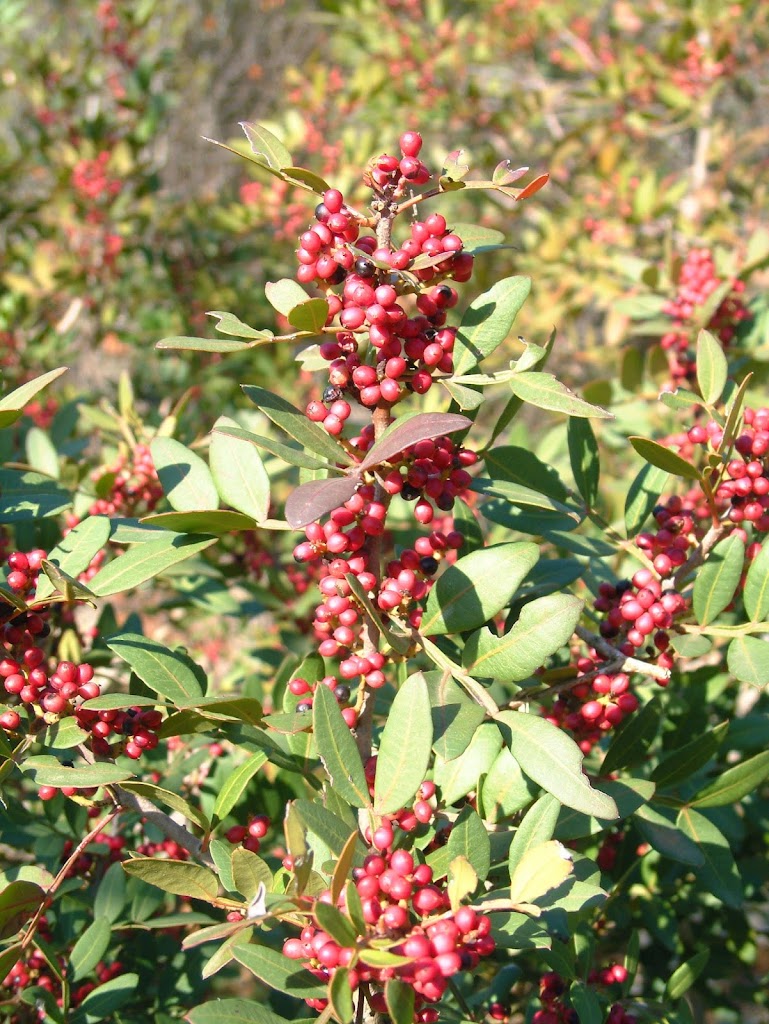 |
| Pistacia lentiscus berries |
Our arrival at a new home in Portugal several years ago has meant learning about different plants, both native and introduced, suited to a long summer drought and winter rainfall–classic mediterranean gardening–we hope!
Our four acres are long neglected agricultural land on the eastern Algarve with olive, carob, almond and pomegranate trees. There are remains of terraced areas and many stone walls, which bizarrely remind me of another limestone area, the Yorkshire Dales, but here it is somewhat warmer! The shrub
backbone is provided by the native Pistacia lentiscus, which is related to, but not the producer of pistachio nuts. It is a tough drought resistant evergreen with a lovely natural rounded habit which can be hard pruned if needed. In late summer it produces clusters of small dark red berries and has a divided leaf of fresh green colour most of the year. Its resin has been used in the past to produce a sap for medicines and varnish which has earned it the common name of Mastic bush, and this gives rise to its distinctive musky smell.
The main ground cover seems to be an amazing selection of local ‘weeds’ which include Lavandula, Myrtle, Phlomis, Cistus, Stipa, Festuca and other elegant grasses, including native Thyme, Fennel, Inula and all sorts of thistles and yellow flowered daisy types which I have yet to identify. In the autumn, following the welcome and much needed winter rain, we see little Arisarum popping up all over the place. The carpet of their brown veined hooded
flowers will make my trek to the washing line interesting viewing as I try to avoid the flowers!
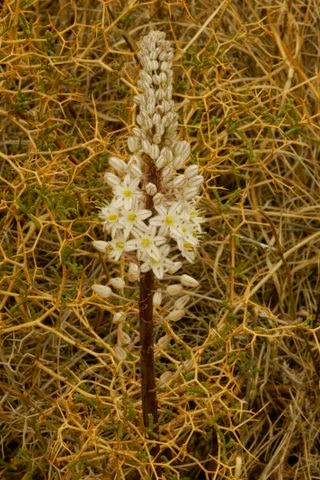 |
| Drimia maritima flower heard |
In early autumn we found some dark red fat buds
breaking through the bare soil and as they developed, they became very tall with a tight spike of flower buds at the top. These proved to be the Sea Quill, Drimia maritima, their white star-shaped flowers with distinctive green veining gradually opening all along the top half of the stem. These bulbs have quite a history and have been used for medicinal purposes since ancient times. Another discovery well worth preserving in our garden.
There are many climbers going up into the trees, Honeysuckle, Smilax and Clematis flammula
which it is interesting to see together for the first time! The clematis is particularly worthwhile as it flowers in early summer with many clusters of small white vanilla scented flowers. Not bad for a weed!
Apart from all this natural splendour, we also found that some brave soul, at some time, actually made a garden near the house. As we have cleared accumulated dead and fallen
branches and undergrowth, we have found strelitzas, numerous oleanders, native palms, a bay tree and lots of Callistemon. There was an unknown tree near the driveway which to all intents and purposes looked as if it were dead. It has thin, almost string-like leaves with
yellow/orange flowers in clusters of small cups along the branches. This is the unusual Parkinsonia acuminata, a native of California, so we hope to give it a new lease of life with some pruning.
The shrubs, which we had trouble identifying during the dry summer, have proved to be forms of Spirea, Cotoneaster and Cassia; Viburnum tinus is also well represented. This is an amazingly drought-tolerant shrub which grows well on our extremely chalky soil with no watering.
We have been really pleased to find that some bulbs, freesias and irises have survived, so we planted more bulbs when rain softened the ground. It was a great thrill to find a group
of the native scented white Narcissus papyraceus near the front of the house. These are the lovely scented Paperwhite narcissus which are sold in flower at Christmas time in the UK.
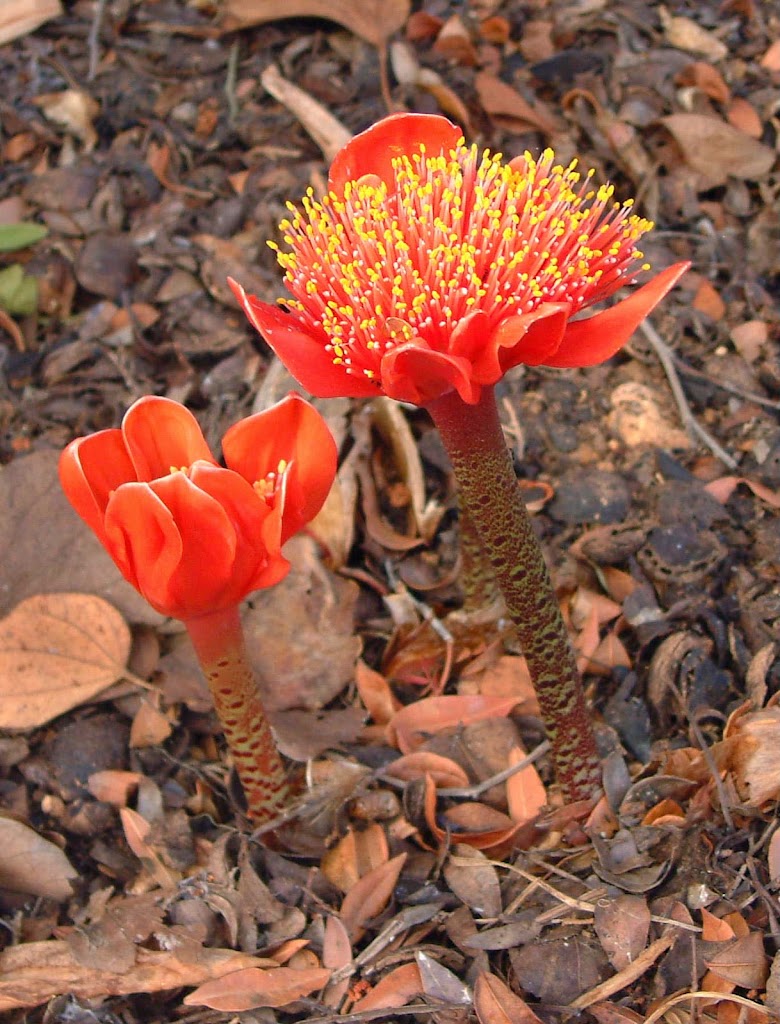 |
| Haemanthus coccineus |
During September, we found a group of over a dozen Haemanthus coccineus, a plant introduced to gardens on the Algarve from South Africa. It is about nine inches high and has a distinctive oval shaped stem with blotches of brown on the light green background colour. The flower is a scarlet bowl holding a mass of florets with golden stamens–a spectacular find!
Whilst clearing the fallen stones and rubble to rebuild a wall, our gardener found a couple of twigs sticking out
of the ground, thinner than a pencil. This was a Bauhinia–the orchid tree. These two bare ´twigs´ are now over two metres
tall and full of large bluey green two-lobed leaves; we saw flowers the following year. These are pink and exotic, giving the impression of a tree covered in floppy orchid flowers, and all because it has been given a second chance with some water and sun.
Many of our olive trees were surrounded by uncontrolled sucker growth which robbed the trees of nutrition and water, these were pruned, and the main stem cleaned. We are delighted to see the grand old trees standing proud once more, with their distinctive knobbly silhouettes revealed. The top growth has felt the benefit, and we now harvest our own olives, both for oil and the table.
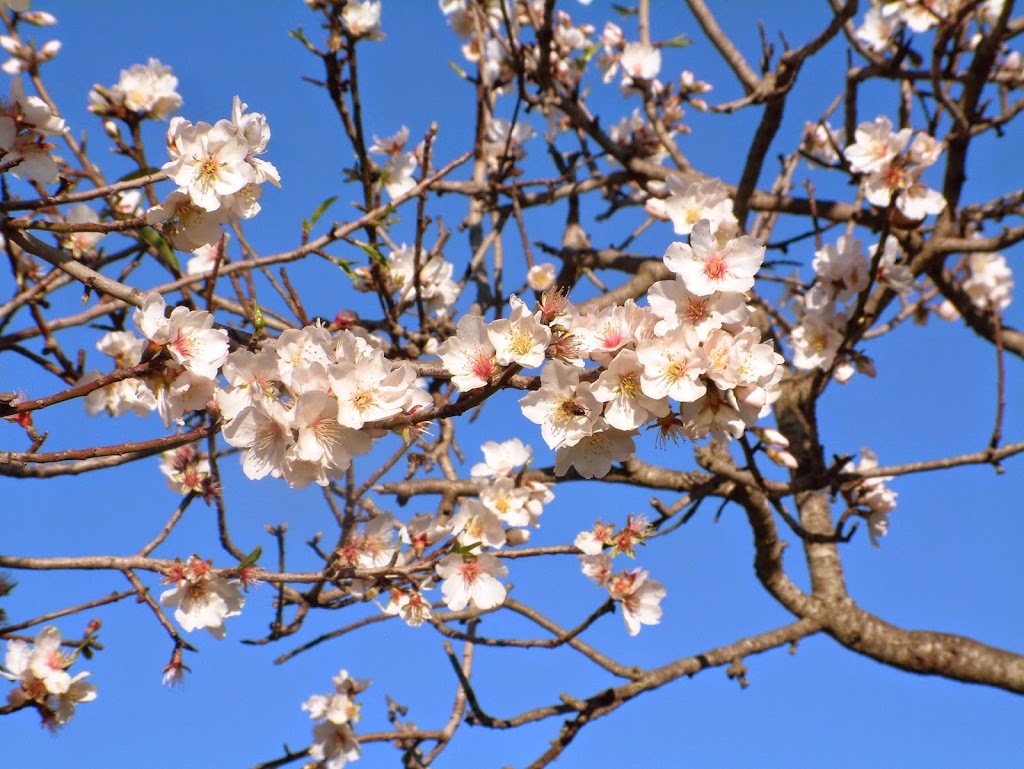 The show of almond blossom during our first winter was a real revelation. We went out on Christmas Day and found some almond trees had already started opening their flowers. This is such a classic sight of the Algarve region that everyone has seen it on postcards, but nothing can beat the joy of standing under a tall almond in full flower and looking through the cloud of pink to that deep blue sky beyond. Magic! Vincent van Gogh famously painted almond trees in bloom, and if it was good enough for him, it is good enough for us.
Later in the year it is the orange blossom which takes over. During late April and May, it can be dangerous to follow me driving round the Algarve: I have the windows open
and can become more than a little intoxicated on the heady sweet perfume from orange groves in full flower. It does not matter that we all know it is ´just another crop´ – orange blossom has always got to be special, and everyone can grow some citrus here, even if it is in a pot on a balcony.
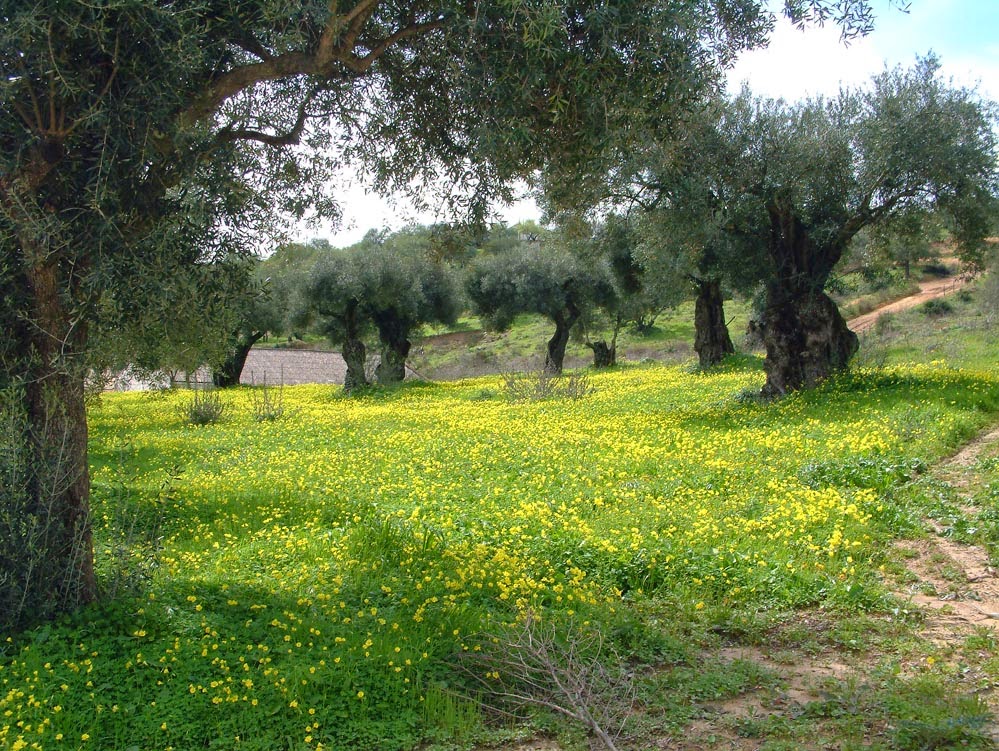 |
| Winter view of olives with the ever-present winter ground cover of oxalis |
With help from our fellow members of the
Mediterranean gardening group, we have been able to identify and enjoy our discoveries. If there is a lesson to be learned from all this, it is do not be tempted to scrape the surface soil or
remove the trees & shrubs of any land until you are satisfied you know what delights might be in store for you through the year. It can be enough to clean out the obvious loose dead and dry stems and branches and let the air, light and the rain
through to the soil so that nature can really show you what it can do! After all, what else might be waiting to be
discovered? As they say in Portuguese: descobrimentos!
Posted by Rosie Peddle
November 2014