Roses in a Mediterranean climate: pain or gain?
 |
| Rosa ‘New Dawn’ filling an arch |
Our last garden in the UK was a small town garden with brick walls and hot sandy soil which dried out quickly, hence the interest in mediterranean plants. The only rose which we managed to grow successfully was the lovely Rosa banksiae lutea, with its long arching thornless branches which are smothered in clusters of small double soft yellow flowers in early summer. Named for the wife of Sir Joseph Banks, the Director of Kew, it was introduced into England from China as long ago as 1824 but it is not completely hardy. It is a vigorous climber and will reach
a height of at least six meters (20 feet) on slender branches. There is a very beautiful double white variety, ‘Alba Plena’, also white and yellow single varieties but they do not have the same allure, nor are they as prolific.
 |
| White rose on pergola in vegetable garden |
The only disadvantage of Rosa banksiae is that it does not flower when very young and takes a year or two to get into full
swing. So successfully did we grow this rose that I had to occasionally check with the neighbours that they also liked having
it on their garden walls! It was the obvious choice to try in our new garden here on the Algarve and it has done well here too. You might occasionally have seen it growing on wire fences or through
trees in gardens here.
There are some roses which will flower throughout the spring and summer. Known as ‘repeats’ they are much sought after. Unfortunately, many of the hybrid roses do not grow well here and are the cause of much heartache, and not a little cursing, as they
shrivel and sulk in the heat. Careful choice is needed for a successful display of the world’s favourite garden plant family: roses. Many Mediterranean climate gardeners find that the climbers and shrub roses do best. As in many other plant choices, local varieties can give the best results. Don’t be afraid to try cuttings from those roses that you see and like locally. You might be rescuing an old variety.
 |
| R. ‘American Pillar’ on trellis |
Recently I was lucky enough to visit a house and garden near Bordeira in the Barrocal area of the central Algarve. The house has been owned by the same family for about 25 years and the wise initial plantings of some spectacular climbing roses were at their peak in May. Enormous cascades of crowded flowering stems were swallowing outbuildings and garden supports, and then there was
the perfume! The owner told me that she had brought some roses from England and had some that were sourced locally.
The lovingly restored old house had many opportunities to show off roses; covering a shallow tiled roof over the barbecue area with peach-coloured blooms was particularly effective. The house is in a small valley and the soil looked very fertile, but this may have been down to the generous use of the home made
compost. There were interesting corners with plants inserted into planting pockets left in the hard surface, a great way to encourage climbers to get their roots under the cool traditional paving. As you enter through the dark blue courtyard entrance doors, there is
a huge swathe of Trachelospermum jasminoides and the perfume from this shower of small white flowers was fabulous.
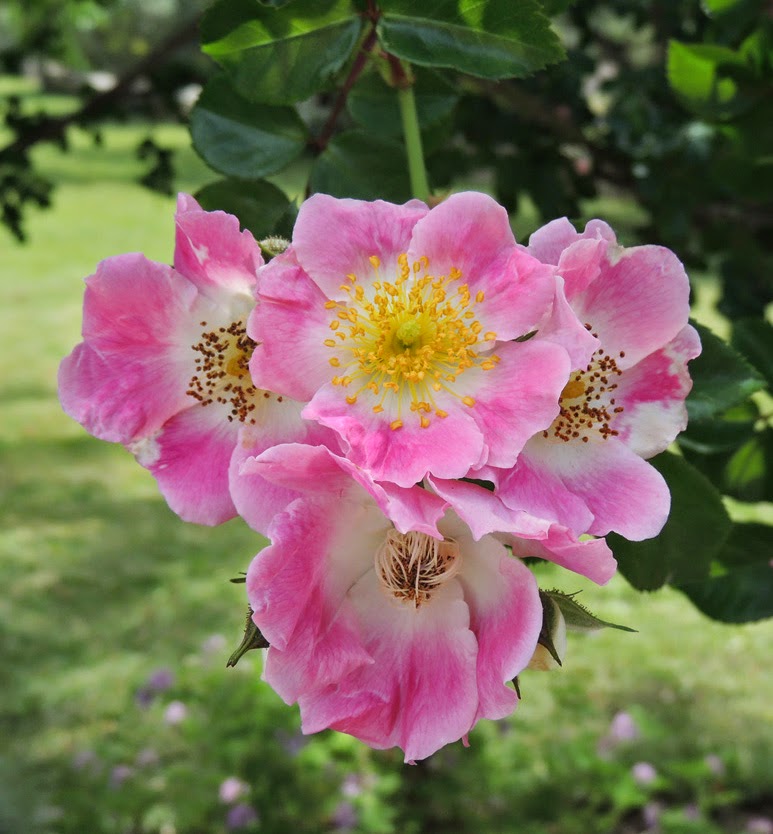 |
| Rosa ‘American Pillar’ |
The vistas from the house out into the garden took in the vegetable plots planted out under huge old fig trees. Shady
conditions for the ‘potager’ providing fresh beans, lettuce, and onions, all laid out to provide good colour contrast and interest for the garden visitor as well as the chef. A very ‘French’ concept transplanted to the Algarve. There is a hectare of land, part of which is an organic vegetable garden and part is being made into a culinary and medicinal herb garden. There is also a flower garden which has been more northern European than Mediterranean up till now. The owner is gradually changing this to planting better adapted to the mediterranean climate.
The axis of the main paths runs through the flower gardens and on into raised beds for vegetable growing so the journey through the garden was full of variety and interest. This is a garden which beckons you on to explore down the pathways to see what awaits you around the next corner. At the moment the roses are the triumphant attention grabbers, but the lovely home-grown lettuces I took home with me were reminders that this garden is
good for the soul and for the taste buds!
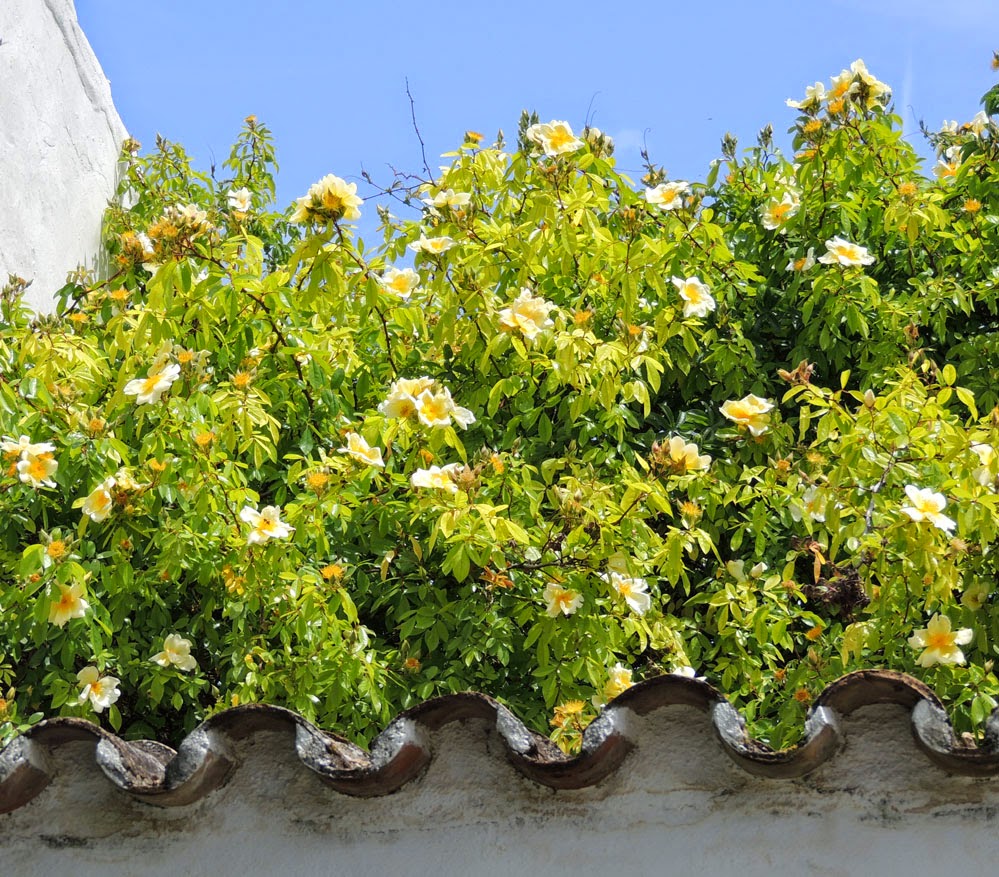 |
| Rosa ‘Golden Showers’ on the house roof |
For more information on roses, there are good growers’ websites such as David Austin Roses and Meilland International. Peter Beales web site is a good place to start; their catalogue is virtually a handbook on rose growing and is very helpful in identifying roses.
Choose your planting position well and avoid competition from nearby plants, feed and water to establish young plants and you can be rewarded with that WOW factor which comes from a well grown
climbing rose.
Posted by Rosie Peddle
November 2014